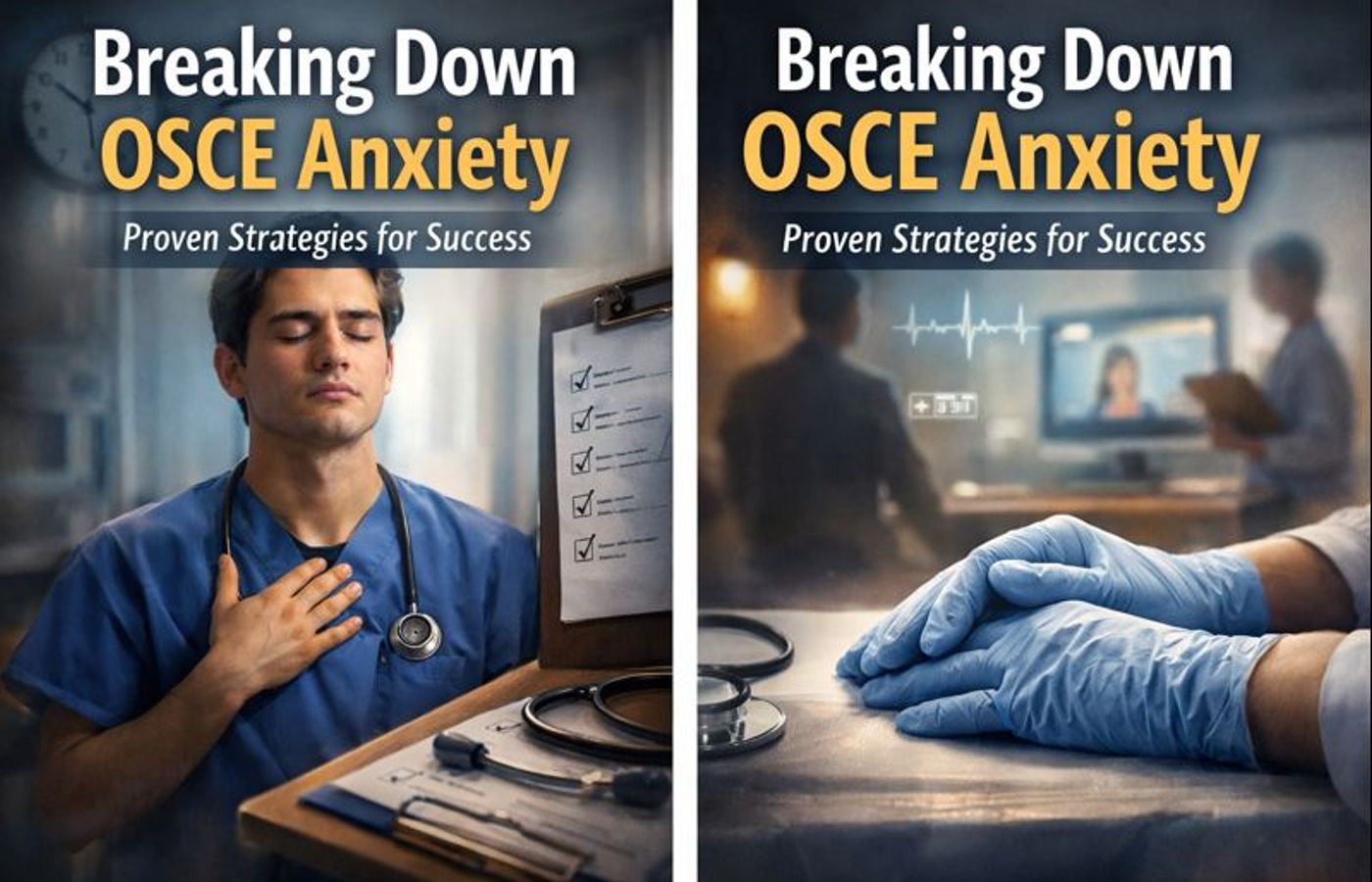
Breaking Down OSCE Anxiety: Proven Strategies for Success
19 Jan 20265 min read
Written by
MV
Maria V.
Nursing Educator
CommunicationOSCE
There’s a moment. Usually right before the bell.
Your gloves feel tighter than they should. Your mouth goes dry. And suddenly, for no logical reason, your brain decides now is the perfect time to forget how to introduce yourself to a patient.
If you’ve ever walked out of an OSCE station thinking, “I know this… why didn’t it come out?” - you’re not alone. Not even close.
OSCE anxiety is real. Very real. And it doesn’t mean you’re unprepared, unintelligent, or “not cut out” for clinical work. Honestly? It usually means the opposite.
Let’s break it down.
What OSCE Anxiety Actually Is (and Why It Hits Hard)
OSCEs aren’t just exams. They’re performances. Under time pressure. With someone watching. Clipboard in hand. Silent. Judging.
Your brain interprets that as a threat.
When that happens, your nervous system flips into survival mode - heart racing, shallow breathing, narrowed attention. Great if you’re running from danger. Terrible if you’re trying to remember BATHE, ICE, or how to close a consultation politely.
This reaction has nothing to do with knowledge gaps. It’s physiology.
And here’s the frustrating part: the more you worry about anxiety, the stronger it gets. A bit of a vicious loop.
The Biggest Myth: “Confidence Comes First”
Let’s clear something up.
Confidence doesn’t magically appear before OSCEs. It usually shows up after repeated exposure.
Most high-scoring OSCE candidates didn’t feel calm their first (or second… or third) time. They learned how to function despite nerves. That’s the real skill.
So if you’re waiting to “feel ready” before practising - stop waiting.
Strategy #1: Practise Feeling Awkward (On Purpose)
Here’s something people don’t say enough: OSCEs are awkward by design.
Talking to a mannequin. Speaking empathy out loud. Explaining things you’d normally do silently. It feels odd. Lean into that.
Instead of only reading scenarios, say everything out loud:
Introductions
Consent
Empathy statements
Safety-netting
Yes, even when you’re alone. Especially when you’re alone.
Your brain needs to hear your own voice under pressure. Otherwise, exam day becomes the first time - and that’s risky.
Strategy #2: Use a Simple Mental Framework (Not a Script)
When anxiety spikes, complex scripts fall apart.
What survives? Structure.
Simple, repeatable frameworks - used across stations - give your brain something solid to grab onto.
For communication-heavy OSCEs, many candidates rely on principles aligned with regulators like Medical Council of New Zealand and General Medical Council, which emphasise:
Clear introductions
Patient-centred language
Empathy and validation
Shared decision-making
You don’t need fancy wording. You need consistent anchors.
When nerves hit, you fall back on structure - not memory.
Strategy #3: Breathe Like You Mean It (Yes, Really)
I know. Everyone says “just breathe.”
But here’s the version that actually works:
Inhale for 4 seconds → Exhale for 6 seconds. Do it twice. Right before the bell.
Longer exhales tell your nervous system, “We’re safe.” Heart rate drops. Thoughts slow. You get a tiny window of clarity - and that’s often enough.
Not perfect calm. Just enough control.
Strategy #4: Stop Trying to Be “Perfect”
This one’s uncomfortable.
OSCEs are not about flawless delivery. They’re about safe, logical, patient-centred practice.
You can:
Miss a question
Pause mid-sentence
Rephrase awkwardly
…and still pass.
Examiners don’t mark your anxiety. They mark what you recover with.
A calm correction often scores more than a rushed, memorised answer.
Strategy #5: Simulate the Pressure - Not Just the Content
Reading stations ≠ OSCE prep.
Timed practice. Spoken answers. Unexpected responses. That’s where anxiety either tightens its grip - or slowly loosens.
This is why OSCE-specific platforms (like gotoMedics) use virtual patients, unpredictable prompts, and strict timers. Not to stress you out - but to normalise the feeling.
Familiar pressure feels smaller.
Strategy #6: Reframe the Examiner (They’re Not the Enemy)
Examiners aren’t waiting for you to fail. Most are clinicians. Many remember their own OSCE nerves vividly.
Try this mental shift:
“They’re checking if I’m safe - not if I’m impressive.”
That changes everything.
Speak clearly. Show empathy. Explain your thinking. That’s usually enough.
What to Do If Anxiety Still Shows Up on the Day
Good. That means you care.
Here’s a quiet truth: some anxiety improves performance. It sharpens focus. Keeps you alert. The goal isn’t zero nerves - it’s control.
When it hits mid-station:
Pause
Acknowledge the patient
Reset with your framework
Examiners notice composure far more than speed.
Final Thought (A Human One)
If OSCEs make you nervous, you’re normal.
The candidates who succeed aren’t the calmest - they’re the ones who practised being uncomfortable until it felt manageable. Over time, something shifts. Your voice steadies. Your mind clears faster. And one day, you walk out thinking:
“That wasn’t perfect… but it was okay.”
That’s usually a pass.
Resources
Company
Legal
Stay Updated
Get updates on OSCE voice practice, communication feedback and preparation resources.