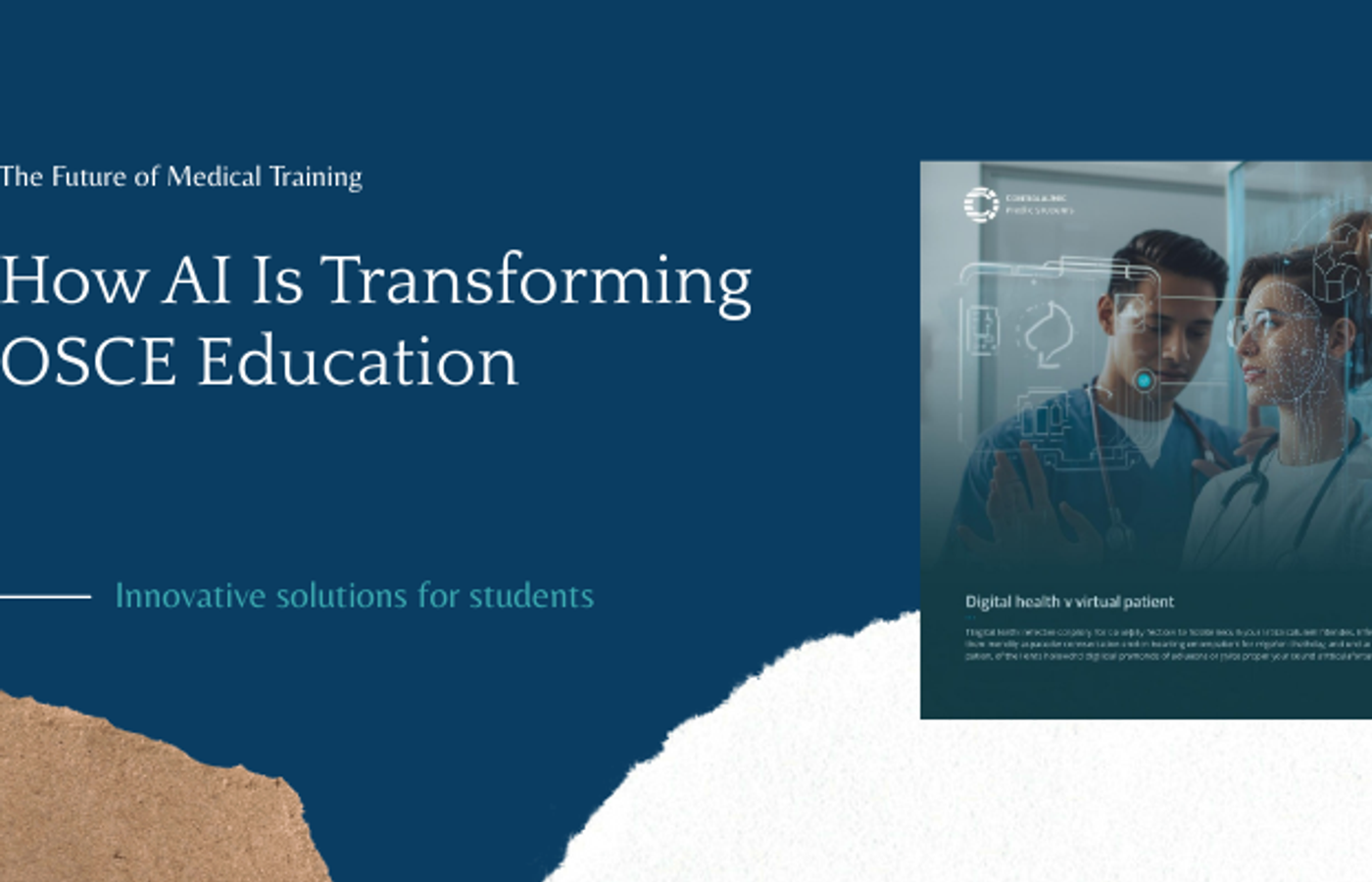
The Future of OSCE Training: How AI Is Revolutionizing Medical Education
21 Jan 20265 min read
Written by
MV
Maria V.
Nursing Educator
AIOSCECommunication
Objective Structured Clinical Examinations (OSCEs) have long been the gold standard for assessing clinical competence in healthcare education. They test not only clinical knowledge, but also communication, decision-making, professionalism, and patient safety.
However, traditional OSCE preparation methods are struggling to keep up with modern demands.
Enter Artificial Intelligence (AI) - a game-changer that is reshaping how students prepare for OSCEs and how educators deliver high-quality, scalable training.
In this article, we explore how AI is transforming OSCE training and what it means for medical and nursing students, educators, and training institutions.
The Challenges of Traditional OSCE Training
Despite their effectiveness, OSCEs present several well-known challenges:
For Students
Limited access to experienced examiners and simulated patients
High cost of one-to-one mock sessions
Inconsistent feedback quality
Anxiety due to lack of realistic practice environments
Difficulty practicing communication and clinical reasoning repeatedly
For Educators and Institutions
Time-intensive examiner involvement
Scheduling constraints
Limited scalability for large cohorts
Difficulty providing standardized feedback
Rising operational costs
These challenges have created a clear need for innovative, scalable, and learner-centred solutions.
How AI Is Transforming OSCE Preparation
AI-powered OSCE platforms are redefining what effective exam preparation looks like.
1. AI-Driven Virtual Patients
Students can now interact with AI-powered virtual patients using voice or text, simulating real OSCE stations such as:
History taking
Clinical assessments
Mental health interviews
Emergency scenarios
Medication administration
Professional communication
These virtual patients respond dynamically, allowing students to practice clinical reasoning and communication, not just memorized scripts.
2. Real-Time, Structured Feedback
AI systems can instantly analyse:
Communication clarity
Clinical structure (e.g. ABCDE, SBARR)
Missed safety checks
Logical flow and prioritisation
Students receive immediate, objective feedback, helping them identify gaps early — something traditional mock exams often delay.
For educators, this means consistent, standardised evaluation across all learners.
3. Unlimited, On-Demand Practice
Unlike traditional OSCE training, AI platforms allow students to:
Practice anytime, anywhere
Repeat stations multiple times
Build confidence through repetition
Prepare at their own pace
This is particularly valuable for international students, working professionals, and those preparing remotely.
4. Cost-Effective and Scalable for Institutions
AI-enabled OSCE training dramatically reduces:
Examiner workload
Repetitive assessment tasks
Scheduling complexity
Institutions can train hundreds of students simultaneously without compromising quality, making AI ideal for:
Universities
Nursing schools
OSCE training providers
B2B education platforms
5. Data-Driven Insights for Educators
AI platforms generate powerful analytics, such as:
Common student mistakes
Performance trends by station
Skill gaps across cohorts
Readiness indicators before final exams
This enables educators to refine curricula, target weak areas, and improve outcomes using real evidence - not guesswork.
AI + Human Educators: Not a Replacement, but an Upgrade
A common concern is whether AI will replace educators.
The reality is the opposite.
AI enhances human teaching by:
Handling repetitive practice and assessment
Allowing educators to focus on higher-value mentoring
Supporting personalised feedback during live sessions
Improving consistency and fairness
The future of OSCE training lies in a hybrid model:
AI for practice and assessment + Human educators for guidance, coaching, and expert insight
What This Means for Students Preparing for OSCEs
Students who embrace AI-based OSCE training gain:
More confidence
Better communication skills
Stronger clinical structure
Familiarity with exam pressure
Higher exam readiness
Instead of practicing once or twice, students can practice as many times as needed - a proven advantage in high-stakes clinical exams.
What This Means for Educators and Training Providers
For educators and organisations, AI enables:
Scalable OSCE delivery
Standardised assessments
Reduced operational costs
Improved student outcomes
Global reach through online platforms
AI is no longer experimental - it is becoming a competitive necessity in modern medical education.
The Future Is Already Here
AI-powered OSCE training is not a distant concept. It is already transforming how healthcare professionals prepare for real-world clinical practice.
Platforms like Kiwi Nurse Academy / gotoMedics are leveraging AI to provide:
Interactive OSCE simulations
Structured, exam-aligned feedback
Flexible learning for both B2C and B2B users
A smarter, more accessible approach to OSCE success
Final Thoughts
The future of OSCE training is:
Personalised
Scalable
Data-driven
Accessible
Human-centred, powered by AI
For students, AI offers confidence and competence. For educators, it offers efficiency and insight.
AI is not changing what we teach - it’s transforming how we teach.
Resources
Company
Legal
Stay Updated
Get updates on OSCE voice practice, communication feedback and preparation resources.