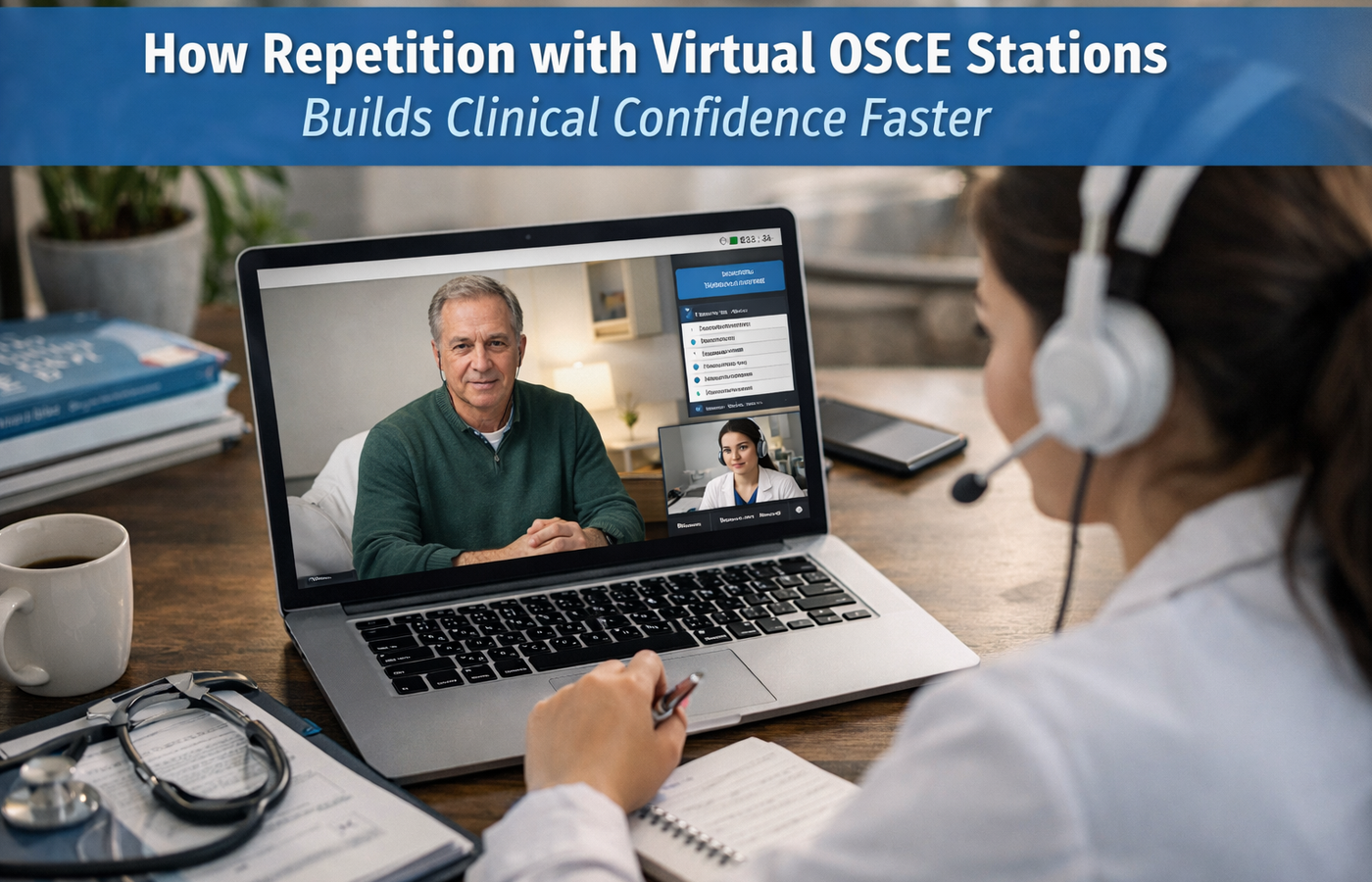
How Repetition with Virtual OSCE Stations Builds Clinical Confidence Faster
23 Jan 20265 min read
Written by
MV
Maria V.
Nursing Educator
OSCEAICommunication
Confidence in clinical practice doesn’t appear overnight. It’s built - slowly, awkwardly at first, then all at once - through repetition. Real repetition. The kind where you say the words, make the mistakes, correct them, and try again without the crushing fear of being judged.
That’s where virtual OSCE stations quietly change the game.
Not in a flashy, sci-fi way. But in a deeply practical, almost boring way. And boring, in medical education, is often exactly what works.
Confidence Isn’t About Knowing More - It’s About Doing More
Ask any student preparing for OSCEs and you’ll hear a familiar story:
“I know the steps… I just freeze when I have to say them out loud.”
This isn’t a knowledge gap. It’s a performance gap.
Clinical confidence grows when three things happen repeatedly:
You recognise patterns instead of memorising scripts
You say clinical language out loud until it stops feeling foreign
You recover from small mistakes and realise nothing terrible happens
Traditional learning hits the first point well. The other two? Not so much.
Virtual OSCE repetition fills that missing space.
Why Repetition Works (and Why It’s Often Missing)
In an ideal world, every student would practise the same OSCE station ten or twenty times with real patients and examiners.
In reality:
Faculty time is limited
Clinical placements are unpredictable
Practice sessions are expensive and stressful
Feedback arrives late - or not at all
So students rehearse silently in their heads. Or read checklists. Or watch someone else do it on YouTube.
Helpful. But incomplete.
Repetition only rewires confidence when it’s active, spoken, and contextual.
Virtual OSCE platforms finally make that possible at scale.
Virtual OSCE Stations: Same Scenario, Zero Penalty
A virtual OSCE station gives students something rare in healthcare training: permission to fail safely.
You can:
Run the same scenario again
Rephrase explanations until they feel natural
Practise silence, empathy, reassurance
Pause, restart, retry
No examiner watching the clock. No awkward reset. No “that was your only attempt”.
And that changes behaviour.
Students stop rushing. They stop panicking. They start experimenting.
That’s where confidence sneaks in.
Repetition Builds Automaticity (and That’s the Secret)
Confidence isn’t bravado. It’s automaticity.
When repetition is effective, students stop thinking:
“What do I say next?”
And start thinking:
“How is this patient feeling right now?”
Virtual OSCE repetition helps automate:
Opening lines (“Can I check your name and date of birth?”)
Safety-netting phrases
Empathetic responses
Structured explanations
Closing summaries
Once these become automatic, mental bandwidth is freed up for clinical reasoning and rapport.
That’s the tipping point.
The Confidence Curve: What We Actually See
Educators using virtual OSCE repetition often notice a clear pattern:
Attempt 1: Hesitant. Scripted. Rigid. Lots of filler words.
Attempt 6–8: Natural language. Calm tone. Real empathy.
Attempt 10+: Confidence without arrogance. Flexible, patient-centred responses.
The station doesn’t change. The student does.
Why Virtual Repetition Beats One-Off Mock OSCEs
One-off mock OSCEs are valuable - but they’re snapshots.
Virtual repetition is a process.
Here’s the difference:
One-off Mock
Virtual Repetition
High stress
Low pressure
Limited attempts
Unlimited practice
Delayed feedback
Immediate reflection
Performance-focused
Learning-focused
Confidence doesn’t grow under constant evaluation. It grows in rehearsal.
Repetition Normalises Clinical Language
A subtle but powerful effect of repetition is linguistic comfort.
At first, students say things like:
“Umm… so basically… what I’m trying to say is…”
After repeated virtual practice:
“Based on your symptoms, I’m concerned about…”
Same knowledge. Different delivery.
Confidence lives in language fluency.
Educators Benefit Too (Quietly, But Significantly)
Virtual OSCE repetition doesn’t replace educators - it protects their time.
Instead of:
Correcting basic structure repeatedly
Repeating the same feedback to multiple students
Educators can focus on:
Nuance
Advanced communication
Clinical judgement
Cultural safety
By the time students reach live sessions, they’re already confident enough to benefit from deeper coaching.
From Exam Confidence to Real-World Confidence
Here’s the part that doesn’t get said enough:
Students who repeat virtual OSCE stations don’t just perform better in exams. They speak more confidently on the ward.
They:
Introduce themselves clearly
Explain procedures calmly
Handle emotional patients better
Ask for help earlier
That’s not exam confidence. That’s clinical confidence.
Final Thought: Confidence Is Practised, Not Taught
You can’t lecture confidence into someone. You can’t PDF it. You can’t checklist it.
But you can practise it.
Over and over. In the same scenario. Until the fear fades and the words flow.
That’s the quiet power of repetition with virtual OSCE stations - and why it builds clinical confidence faster than almost anything else we’ve tried so far.
If you’re designing OSCE training, this isn’t a nice-to-have anymore. It’s the foundation.
Resources
Company
Legal
Stay Updated
Get updates on OSCE voice practice, communication feedback and preparation resources.