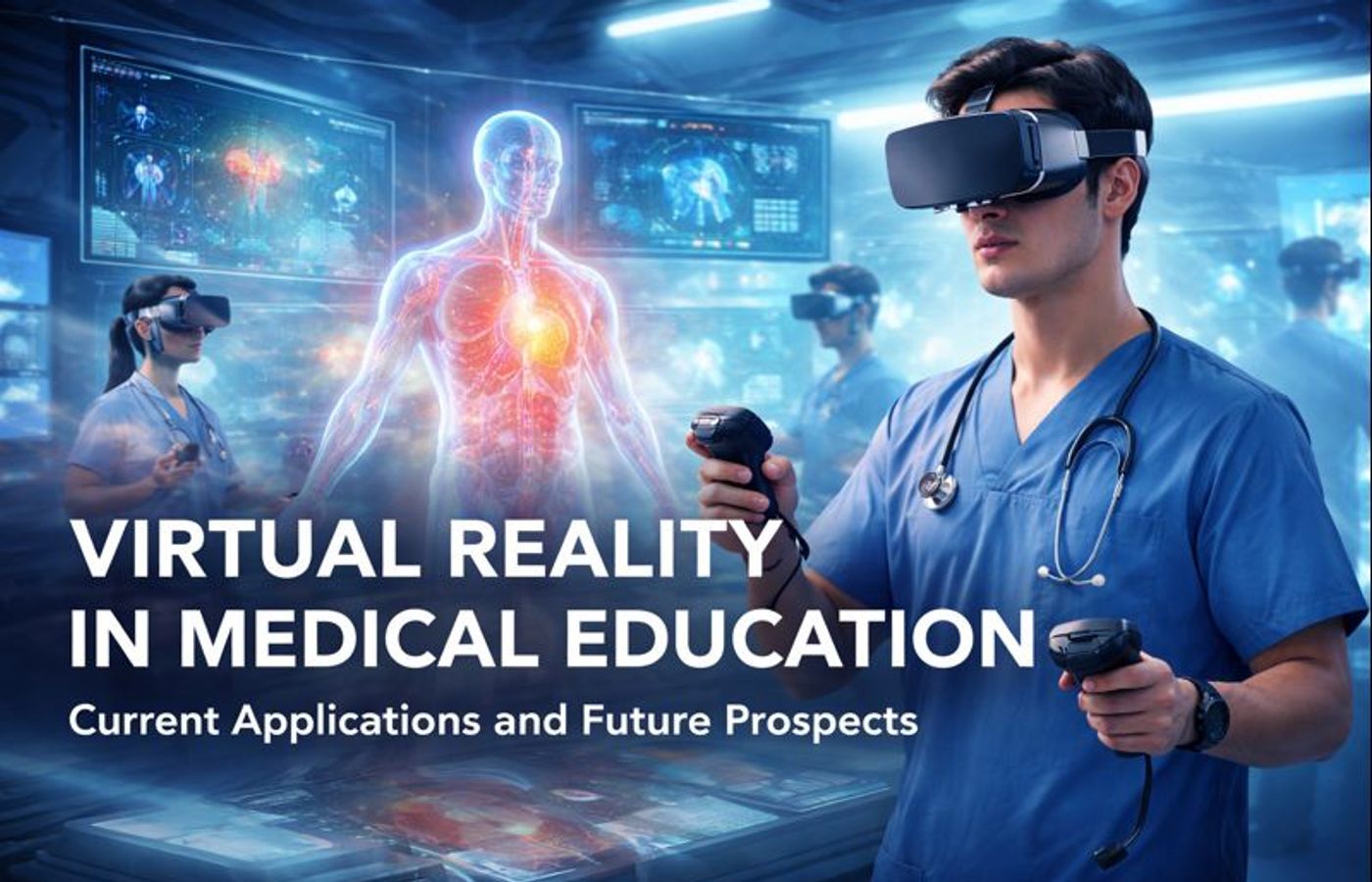
Virtual Reality in Medical Education: Current Applications and Future Prospects
12 Jan 20266 min read
Written by
MV
Maria V.
Nursing Educator
Study TipsCommunication
Funny thing about medical training - it’s always been hands-on, yet oddly limited by reality itself. You get one chance at a real patient, one awkward moment to phrase a question correctly, one narrow window to make the right call. No rewind button. No “let’s try that again, but better.”
That’s where virtual reality (VR) quietly walks in, kicks its shoes off, and changes the rules.
Not loudly. Not overnight. But steadily - and in ways that are starting to matter.
What VR Really Means in Medical Education (Beyond the Headset Hype)
When people hear “VR,” they picture flashy goggles and sci-fi vibes. Fair enough. But in medical education, VR isn’t about looking cool - it’s about in situations that normally take years (and a bit of luck) to encounter.
feeling present
Put simply: VR creates simulated clinical worlds where learners can practice safely, fail privately, and repeat endlessly.
No patient harm. No examiner breathing down your neck. No wasted learning moments.
And yes, the tech has matured enough that this isn’t just a gimmick anymore.
Current Applications of VR in Medical Training
1. Clinical Skills and Procedural Training
Let’s start with the obvious win.
VR is now widely used to simulate procedures - suturing, cannulation, catheterisation, even laparoscopic surgery. Trainees can practice hand movements, sequencing, and decision-making with real-time feedback.
Some systems integrate haptic feedback, so mistakes feel wrong. Slightly unsettling, actually. In a good way.
Institutions working with platforms like Osso VR have already reported improved procedural confidence before students ever step into a real clinical environment.
And confidence, as anyone who’s survived an OSCE knows, matters.
2. Anatomy: From Flat Pages to Walk-Inside Learning
Cadaver labs are invaluable - but expensive, limited, and logistically complex.
VR anatomy flips the script.
Students can walk through the thoracic cavity. Rotate organs. Peel away layers. Reset. Repeat. Zoom in again.
Tools inspired by platforms such as Meta’s immersive ecosystems allow learners to engage spatially with anatomy in ways textbooks simply can’t manage - no matter how glossy the diagrams are.
And oddly enough, students remember more. Spatial memory sticks.
3. Communication and OSCE-Style Scenarios
Now this part? This is where things get really interesting.
VR is increasingly used to simulate patient interactions - breaking bad news, managing an angry relative, conducting mental health assessments, or explaining a diagnosis under pressure.
Instead of memorising scripts, learners experience the emotional weight of conversations. Virtual patients pause. Interrupt. React. Get upset. Sometimes go quiet.
Which feels uncomfortably real. And that’s exactly the point.
For OSCE preparation - especially communication-heavy stations - VR bridges the gap between theory and real-world performance.
4. Emergency and High-Risk Scenario Training
Some scenarios are too rare - or too dangerous - to practise regularly.
Cardiac arrest. Mass casualty events. Rapid patient deterioration at 2 a.m.
VR allows teams to train for these moments without real-world consequences. Learners can rehearse decision-making under pressure, practise teamwork, and refine clinical judgement.
Mistakes don’t cost lives. They cost learning points.
Hospitals collaborating with research institutions like Stanford University have explored VR for team-based crisis simulations - and the outcomes are quietly impressive.
Why VR Works So Well for Medical Learning
Here’s the thing. Humans don’t learn best by reading alone. We learn by doing. By feeling. By messing up.
VR taps into something deeper than traditional e-learning:
Embodied learning – your brain treats the experience as real
Emotional engagement – stress, empathy, urgency all play a role
Repetition without penalty – practise until it feels natural
Standardisation – every learner faces the same scenario, every time
That combination is powerful. Almost unfair, honestly.
The Role of VR in the Future of OSCE Training
OSCEs aren’t just about clinical knowledge. They’re about how you communicate, prioritise, reassure, and adapt - often within painfully tight time limits.
VR is uniquely positioned to support this.
Imagine:
Practising the same OSCE station multiple times with different patient personalities
Receiving structured feedback on tone, pacing, and empathy
Training remotely, without booking physical mock sessions
Reducing anxiety by turning the “unknown” into something familiar
This is especially valuable for international candidates, remote learners, and professionals balancing study with work and family life.
Not perfect yet. But heading there.
Challenges (Because Yes, There Are a Few)
Let’s not pretend VR is flawless.
Cost – high-quality systems aren’t cheap
Access – not every institution or student can jump in immediately
Tech literacy – some learners need time to adapt
Human nuance – AI-driven patients are improving, but still learning
That said, costs are falling, hardware is improving, and realism is increasing fast. Faster than most people expect.
What the Next 5–10 Years Might Look Like
Here’s my honest take.
VR won’t replace traditional clinical training. Nor should it. But it will become a core pillar of medical education - especially for:
OSCE and communication skills
Early-stage clinical exposure
Rare or high-risk scenario preparation
Remote and flexible learning models
We’ll likely see tighter integration with AI, adaptive virtual patients, voice-based assessments, and personalised feedback loops.
The line between “practice” and “real” will blur a little more each year.
Final Thoughts (No Neat Bow, Just Reality)
Medical training has always demanded excellence under pressure. VR doesn’t lower that bar - it helps learners reach it sooner, safer, and with fewer bruises along the way.
For students, it’s confidence without consequences. For educators, it’s consistency and scale. For patients - eventually - it’s better-prepared clinicians.
And that feels like progress worth leaning into.
If you’re exploring the future of OSCE prep or communication-focused medical training, VR isn’t “coming someday.”
It’s already knocking.
Resources
Company
Legal
Stay Updated
Get updates on OSCE voice practice, communication feedback and preparation resources.