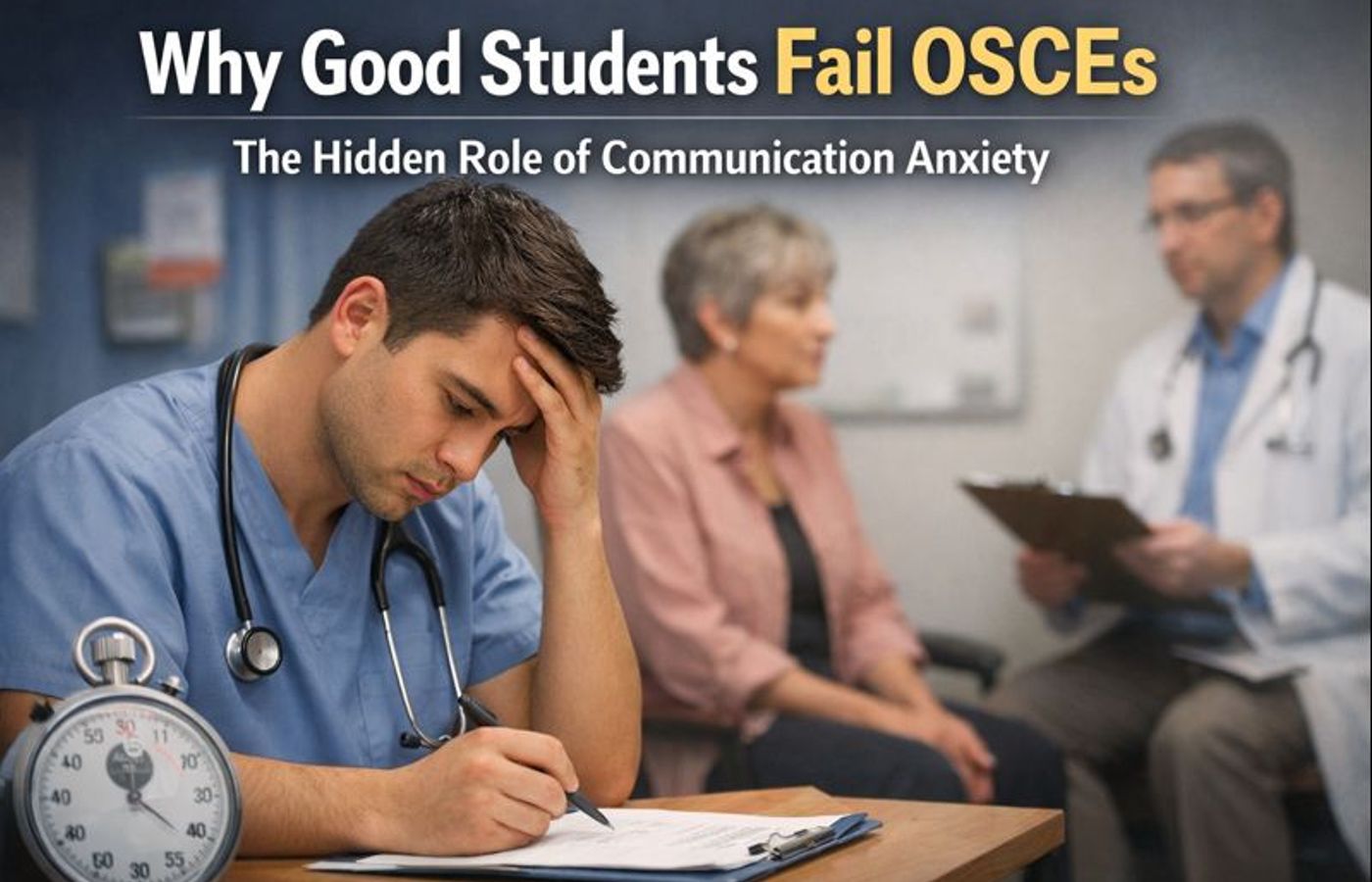
Why Good Students Fail OSCEs: The Hidden Role of Communication Anxiety
25 Jan 20265 min read
Written by
SJ
Serena J
Nursing Educator
OSCEStudy Tips
It’s one of the most frustrating moments in medical education.
You know the content. You’ve revised the guidelines. You’ve passed written exams comfortably.
And yet - inside the OSCE room - something slips. Words feel clumsy. Your mind goes oddly blank. The patient looks at you, waiting… and suddenly the clock feels loud.
This isn’t about intelligence. Or laziness. Or poor preparation.
More often than not, it’s communication anxiety - quiet, underestimated, and brutally effective at sabotaging even the strongest students.
Let’s talk about it. Honestly.
The OSCE paradox: knowledge-rich, performance-poor
OSCEs are strange beasts.
They don’t ask what you know. They ask how you show it - under pressure, out loud, while being watched.
Many high-performing students fall into this paradox:
Excellent theoretical understanding
Clear clinical reasoning on paper
Strong recall in calm environments
But put them in front of a simulated patient and examiner? The performance dips. Sometimes sharply.
Why?
Because OSCEs are communication exams disguised as clinical assessments.
And anxiety doesn’t care how smart you are.
What communication anxiety actually looks like (hint: it’s not always obvious)
Communication anxiety isn’t always shaking hands or visible panic.
In OSCEs, it often shows up in subtler ways:
Overly scripted, robotic speech
Rushing through questions without listening
Forgetting to signpost or explain reasoning
Avoiding eye contact while “thinking”
Jumping straight to management without empathy
Awkward silences that feel longer than they are
Students later say things like:
“I knew what to ask, but it didn’t come out right.” “I forgot to reassure the patient - even though I always do that in practice.” “My head just felt… noisy.”
That noise? Anxiety.
Why OSCE communication anxiety hits good students harder
Ironically, high-achieving students are often more vulnerable.
Here’s why.
1. Perfectionism backfires
Good students tend to hold themselves to high standards. In OSCEs, that can turn into:
Overthinking every sentence
Fear of saying the “wrong” thing
Mental self-monitoring instead of patient focus
The result? Reduced fluency and warmth.
2. Cognitive overload under pressure
Anxiety eats up working memory.
So instead of:
Listening
Responding naturally
Building rapport
Your brain is busy juggling:
“What’s next on the checklist?”
“Am I being marked down?”
“Don’t forget ICE… no, empathy… no, consent…”
Even solid knowledge struggles to surface cleanly.
3. Lack of spoken practice
Many students revise silently:
Reading notes
Watching videos
Running scenarios in their head
But OSCEs demand verbal performance. If you haven’t practised speaking out loud, anxiety fills the gap.
The myth that “confidence just comes naturally”
Let’s clear this up.
Confident OSCE performers are rarely “naturally confident.” They’re usually trained communicators.
Confidence in OSCEs is:
Familiarity with structure
Repetition under realistic conditions
Comfort with uncertainty
Practice recovering when things go wrong
In other words - confidence is built, not inherited.
How anxiety quietly destroys marks (even when answers are correct)
Examiners don’t just listen for content. They observe process.
Communication anxiety can lead to:
Missing empathy points
Poor explanation of reasoning
Disorganised history-taking
Inadequate safety-netting
Weak closure and summarisation
You might still ask the right questions - but not in a way that earns full marks.
That’s how “good students” end up confused by disappointing OSCE results.
Why traditional revision doesn’t fix this
More notes won’t help. More guidelines won’t help. Another textbook? Probably not.
Because the issue isn’t knowledge - it’s performance under interpersonal pressure.
OSCE communication anxiety sits at the intersection of:
Psychology
Habituation
Verbal fluency
Emotional regulation
And that requires a different kind of practice.
What actually helps reduce OSCE communication anxiety
This is where things shift.
1. Practising with realistic pressure
Low-stakes repetition matters. Practising in environments that feel close to OSCEs - timed, spoken, slightly uncomfortable - teaches your brain that the situation is survivable.
2. Speaking, not thinking
You need to rehearse:
Opening lines
Transitions
Empathy statements
Explanations
Closures
Out loud. Repeatedly. Awkwardly at first.
That awkwardness fades. Anxiety follows.
3. Normalising imperfection
Strong OSCE performers aren’t flawless. They:
Pause
Rephrase
Correct themselves
Acknowledge uncertainty
And they keep going.
Learning that you don’t need to be perfect is strangely liberating.
4. Exposure to different patient personalities
Communication anxiety spikes when students face the unexpected:
Silent patients
Emotional patients
Confused patients
Practising with variety builds flexibility - and calm.
The role of virtual OSCE practice (and why it works)
This is where modern OSCE prep shines.
Virtual OSCE platforms allow students to:
Practise speaking without fear of judgement
Repeat scenarios multiple times
Make mistakes safely
Build fluency before live assessments
By the time students face a real examiner, the format no longer triggers panic.
The brain says: “Oh. This again. I’ve done this before.”
And anxiety loosens its grip.
A quiet truth students don’t hear enough
Failing - or underperforming - in OSCEs does not mean:
You’re bad at medicine
You lack clinical ability
You’re not cut out for healthcare
Often, it means:
You haven’t been trained for performance yet.
That’s fixable. Completely.
Final thought: OSCEs reward calm communication, not brilliance alone
OSCE success isn’t about dazzling examiners with encyclopaedic knowledge.
It’s about:
Being understandable
Being human
Being structured
Being present
And managing the anxiety that tries to get in the way.
Good students don’t fail OSCEs because they’re weak.
They fail because communication anxiety is invisible, unaddressed, and underestimated.
Once you train for that - everything changes.
Slowly at first. Then all at once.
Resources
Company
Legal
Stay Updated
Get updates on OSCE voice practice, communication feedback and preparation resources.