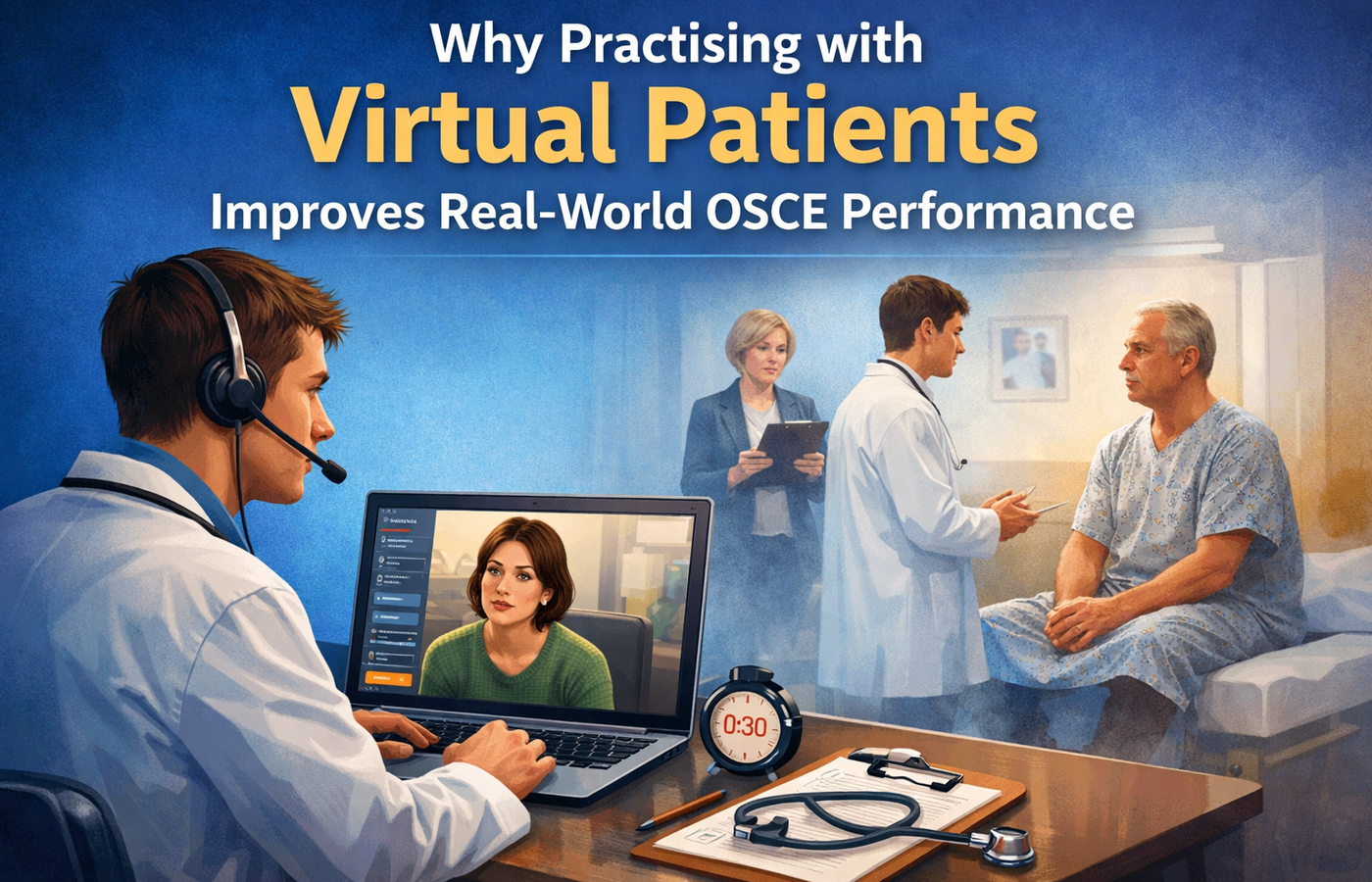
Why Practising with Virtual Patients Improves Real-World OSCE Performance
23 Jan 20265 min read
Written by
MV
Maria V.
Nursing Educator
OSCEAI
There’s a moment in every OSCE that feels oddly louder than the rest. The knock on the door. The examiner’s clipboard. The patient looking up. Heart rate spikes. Mouth goes dry. Brain suddenly forgets the opening line you practised a hundred times.
Here’s the uncomfortable truth most candidates realise a bit too late: knowing the content isn’t the same as performing under pressure. And this is exactly where practising with virtual patients quietly, almost sneakily, changes the game.
Not in a flashy, sci-fi way. In a very human one.
OSCEs Test Performance, Not Memory (And That’s the Catch)
On paper, OSCEs look straightforward. History taking. Communication. Clinical reasoning. Safety checks. Closure.
In reality? They’re a performance exam.
You’re expected to:
Think clinically while listening
Speak clearly while managing nerves
Show empathy while remembering marking criteria
Stay structured while adapting to unpredictable patient responses
That’s a lot to juggle. Traditional study methods - reading stations, memorising phrases, watching videos - prepare your knowledge. They don’t train your brain in motion.
Virtual patients do.
Practise Without the Pressure (So You Can Handle It Later)
One underrated advantage of virtual patient practice is psychological safety.
No examiner watching. No awkward silence. No fear of “messing it up.”
You can:
Pause
Restart
Try a different phrasing
Reflect mid-station (yes, really)
That low-stakes environment gives your brain permission to experiment. And experimentation is how real learning sticks.
Ironically, removing pressure during practice is what builds resilience under pressure later.
Repetition Builds Automaticity (The OSCE Superpower)
In high-stress situations, your brain doesn’t rise to the occasion - it falls back on patterns.
Virtual patients let you repeat the same type of interaction multiple times:
Opening a consultation
Exploring red flags
Responding to emotion
Explaining management plans
Not once. Not twice. Over and over, in slightly different ways.
Eventually, something clicks.
You stop thinking, “What should I say next?” And start thinking, “What does this patient need right now?”
That shift - from scripted to natural - is gold in an OSCE.
Realistic Mistakes, Safe Consequences
Here’s something students rarely admit out loud: They avoid practising parts they’re bad at.
Breaking bad news. Handling anger. Managing silence.
Virtual patients don’t judge. They also don’t rescue you.
If you:
Interrupt too much → the patient shuts down
Miss an emotional cue → rapport suffers
Use jargon → confusion shows
These are consequential mistakes, but safe ones. And they mirror real OSCE marking outcomes frighteningly well.
You learn not because someone tells you, but because you feel the impact.
That’s powerful.
Communication Skills Improve Faster Than You Expect
Communication is often described as “soft.” In OSCEs, it’s anything but.
Virtual patients force you to:
Listen actively (not just wait to speak)
Adapt language to patient understanding
Manage emotions in real time
Structure explanations clearly
What surprises many candidates is how quickly their communication improves once they practise aloud instead of silently.
Reading empathy phrases doesn’t build empathy. Saying them - awkwardly at first - does.
Clinical Reasoning Becomes Visible (To You and the Examiner)
In OSCEs, it’s not enough to know the diagnosis. You must show your thinking.
Virtual patient scenarios naturally push you to:
Ask focused questions
Link symptoms logically
Summarise findings coherently
Justify next steps out loud
That habit of verbal reasoning carries straight into the exam room. Examiners love clarity. Virtual practice trains it without you even realising.
Sneaky. In a good way.
Timing Stops Being Your Enemy
Almost every OSCE candidate struggles with time.
Too slow at the start. Rushed at the end. Closure forgotten. Again.
Virtual patient practice - especially timed sessions - helps you internalise pacing:
How long history really takes
When to redirect politely
How to close confidently without sounding abrupt
Eventually, your internal clock calibrates. You stop fighting the timer and start using it.
That alone can lift scores noticeably.
Confidence Grows Quietly, Then All at Once
Confidence from reading is fragile. Confidence from doing is durable.
After enough virtual patient interactions, something subtle happens:
Your openings feel natural
Your voice steadies
You recover faster from mistakes
By the time you walk into a real OSCE station, it doesn’t feel new. It feels… familiar. Almost routine.
That’s not arrogance. That’s preparedness.
Virtual Patients Don’t Replace Humans - They Prepare You for Them
Let’s be clear: virtual patients aren’t here to replace instructors, simulated patients, or real clinical exposure.
They fill the gap between theory and performance.
They’re the rehearsal before the spotlight. The muscle memory before the sprint. The quiet reps before the big day.
And in an exam where small behavioural details make a big difference, that preparation matters.
A lot.
Final Thought (The Honest One)
If OSCE success were just about knowing what to say, fewer capable candidates would struggle.
But OSCEs test how you perform as a clinician - under time pressure, emotional load, and scrutiny.
Virtual patients train that performance layer. Repeatedly. Safely. Effectively.
Not glamorous. Not magic.
Just deeply, reliably effective.
And sometimes, that’s exactly what you need.
Resources
Company
Legal
Stay Updated
Get updates on OSCE voice practice, communication feedback and preparation resources.